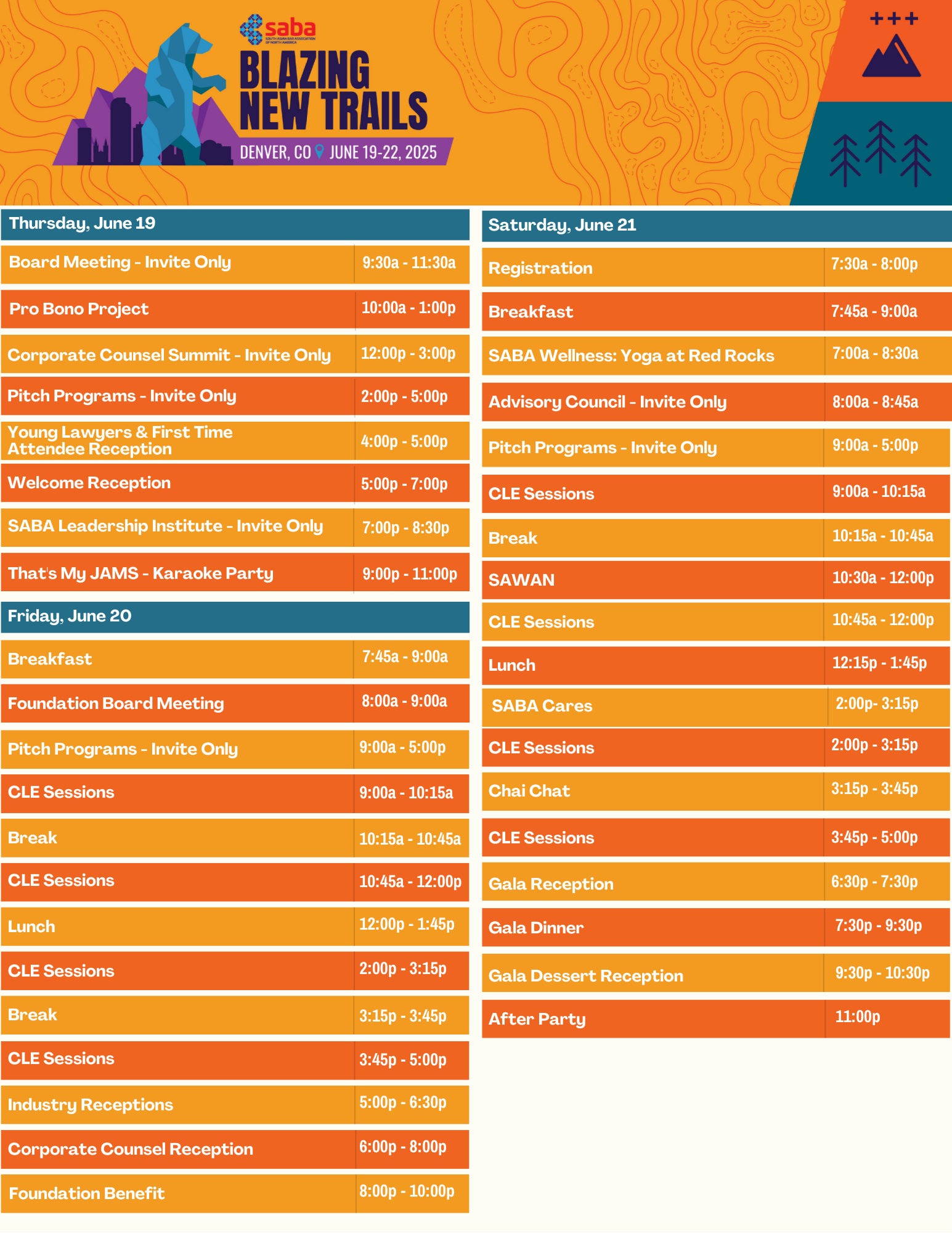
2025 Conference Agenda
Please note, the conference agenda is subject to change!
CLE Panels
1. Back to the Future: Trump’s Immigration Agenda for 2025 and Beyond
As workplaces become increasingly divided along political, cultural, and social lines, employers are facing a new wave of harassment and discrimination claims that intersect with free speech, shifting legal standards, and evolving social media frameworks. This panel will explore how organizations can navigate these complex and often controversial issues while maintaining compliance, protecting employees, and fostering an inclusive environment.
Topics will include:
• The impact of recent executive orders and legislation on employer obligations
• Managing employee and managerial speech related to race, gender, religion, and global events (e.g. political protests)
• Legal risks around reverse discrimination claims and dismantling of race- or identity-based programs
• The evolving definition of harassment in the age of social media and remote work
• Best practices for investigating complaints and avoiding retaliation claims in a hyper-politicized environment
• How to craft policies that respect employee expression while upholding anti-discrimination and anti-harassment standards
Panelists will include employment attorneys, corporate counsel, and inclusivity leaders who bring a range of perspectives from both the legal and organizational trenches. Attendees will walk away with practical strategies for reducing legal exposure and building resilient, legally compliant workplace cultures amid uncertainty.
2. Navigating Harassment and Discrimination Claims in a Polarized Era
As workplaces become increasingly divided along political, cultural, and social lines, employers are facing a new wave of harassment and discrimination claims that intersect with free speech, shifting legal standards, and evolving social media frameworks. This panel will explore how organizations can navigate these complex and often controversial issues while maintaining compliance, protecting employees, and fostering an inclusive environment.
Topics will include:
• The impact of recent executive orders and legislation on employer obligations
• Managing employee and managerial speech related to race, gender, religion, and global events (e.g. political protests)
• Legal risks around reverse discrimination claims and dismantling of race- or identity-based programs
• The evolving definition of harassment in the age of social media and remote work
• Best practices for investigating complaints and avoiding retaliation claims in a hyper-politicized environment
• How to craft policies that respect employee expression while upholding anti-discrimination and anti-harassment standards
Panelists will include employment attorneys, corporate counsel, and inclusivity leaders who bring a range of perspectives from both the legal and organizational trenches. Attendees will walk away with practical strategies for reducing legal exposure and building resilient, legally compliant workplace cultures amid uncertainty.
3. The Art of *Appealing* to the Appellate Bench
Join us as we pull back the curtain on the art and science of appellate advocacy. Notable South Asian judges and appellate advocates will come together to discuss and debate high-level strategic choices as well as more granular tips and tricks.
4. The Rule of Law Under Trump II: Institutional Resilience, Enforcement Trends, and the Future of U.S. Governance
As the second Trump administration moves through its first year, key institutions—including federal agencies, the courts, enforcement bodies, law firms, and public and private companies—face unprecedented challenges. How has the rule of law been tested, and how are institutions adapting? This panel brings together former government officials, nonprofit advocates, and legal practitioners to assess how the current administration’s policies are reshaping regulatory oversight, prosecutorial discretion, agency independence, and how private and public institutions are addressing these issues. Topics will include shifts in corporate and white-collar enforcement, the courts’ role in checking executive power, and the broader implications for legal stability in the U.S. and abroad.
5. Mastering Expert Testimony in Patent Trials: Strategies for Persuasion and Clarity Before a Jury
This interactive session will focus on effectively presenting expert testimony regarding patent infringement before a jury, addressing the unique challenges of simplifying complex technical and legal issues for a lay audience. Through a dynamic mock direct and cross-examination, seasoned patent litigators will demonstrate strategies for making expert testimony compelling, credible, and accessible. Attendees at the SABA conference will engage as a jury with different perspectives in a fictional yet realistic patent dispute, gaining practical insights into how judges and juries evaluate expert testimony. This session will provide valuable techniques for refining expert presentations, enhancing persuasion, and avoiding common pitfalls in high-stakes patent litigation.
6. Beyond Borders: Advancing South Asian Justice & Advocacy in North America
The South Asian diaspora is one of the largest and fastest-growing communities in North America, yet it continues to face significant challenges related to access to justice, equity, and inclusion. In Canada, South Asians are the largest racialized community, facing disproportionate poverty rates, a racial wage gap, and rising hate crimes. In the U.S., issues such as racial and religious profiling, workplace discrimination, and barriers to legal access persist.
This session brings together legal professionals and advocates to examine the intersection of race, gender, and class in shaping South Asian experiences in North America. Through real-world cases and advocacy efforts, panelists will explore:
Recent law reform and advocacy efforts impacting South Asians in Canada and the U.S.
Landmark legal cases, including Supreme Court interventions by South Asian legal organizations.
The role of cultural and spiritual literacy in combating discrimination and advancing systemic change.
Challenges faced by South Asian international students and the need for culturally informed legal services.
Framed as a roundtable discussion, this session will highlight the ongoing efforts of organizations like SALCBC, SALCO, and SABA in pushing for legal and policy changes. Attendees will gain insights into how they can leverage their roles as legal professionals to promote fairness, inclusion, and equity while navigating the complexities of identity and advocacy in a multicultural society.
7. Unpacking SCOTUS 2025
As the U.S. Supreme Court's 2024-2025 term unfolds, its rulings are set to shape the legal and political landscape for years to come. This panel will provide a deep dive into the Court's most consequential decisions and the key arguments that defined them. Legal experts will analyize rulings that impact constitutional rights, administrative power, employment rights, disability rights and more, offering insights into the Court's evolving judicial philosophy and its broader implications. This panel is essential for legal professionals, policymakers, and anyone seeking to understand the Supreme Court's pivotal role in shaping the law.
8. RJTF Presents - United in Resistance: A Comprehensive Discussion on Caste Discrimination
For centuries, both Black and Dalit communities have resisted deeply entrenched systems of oppression. This Juneteenth, join us for a powerful discussion on the intersections of race, caste, and law, exploring how these communities united in the fight for justice. This panel will highlight historical parallels, ongoing struggles, and the pathways toward collective liberation.
Our distinguished panelists bring their expertise from activism, legal advocacy, and scholarship. Join us for this critical conversation on solidarity, resistance, and justice.
9. Crypto at a Crossroads: Legal Challenges, Regulatory Shifts, and What’s Next
The legal landscape for crypto is evolving at breakneck speed, with high-stakes lawsuits, aggressive regulatory crackdowns, and landmark court decisions redefining the industry. Whether you’re a firm lawyer, general counsel, investor, entrepreneur, or crypto enthusiast, understanding these legal shifts is critical to navigating what’s next.
This panel brings together some of the nation’s top crypto attorneys to break down the latest enforcement actions, regulatory moves, and court cases shaping digital assets, blockchain, and Web3. We’ll explore the legal battles making headlines, the compliance challenges keeping companies up at night, and the opportunities emerging from the chaos.
Expect a fast-paced, no-nonsense discussion packed with insights and analysis to help you anticipate risks, adapt to regulatory uncertainty, and seize new opportunities in the world of crypto.
10. The Trade Tides Have Turned: Navigating Tariffs, Sanctions & Global Shifts in Trump’s Second Term
President Trump has returned to the White House and global trade is once again in flux. With the administration’s focus on "America First" policies, heightened tariffs, and aggressive trade sanctions, businesses and governments worldwide must get ready for a new era of economic uncertainty.
This panel will break down the geopolitical and economic implications of Trump's second term, including the impact of new tariffs—such as the 25% duty on Canadian imports—on key industries. Experts will analyze the administration’s shifting approach to trade alliances, evolving sanctions on Russia and China, and the ripple effects on economies like India and the broader global market. Attendees will gain insights into how businesses can mitigate risks, how legal practitioners can navigate compliance challenges, and what trade strategies are emerging in response to these policies.
11. Checkmate in Class Actions: Mastering Offensive and Defensive Strategies.
Class action lawsuits are among the most complex and high-stakes challenges a company can face, often regarded as a “DEFCON 1” event for legal departments and internal stakeholders. This panel brings together leading class action defense and plaintiff attorneys to explore the intricacies of these cases from dueling perspectives. Each side will offer their views from the high-risk dynamics to the societal impact. Through candid discussions and practical advice, attendees will gain a nuanced understanding of how class actions are conceived, and actionable strategies for defendants navigating them effectively.
Whether you’re defending your company from its first-class action or managing a portfolio of complex litigation, this session will equip you with insights to define success on your terms.
Key Themes to Address:
1. What Is a Class Action Lawsuit?
- Defense Perspective: Why these cases are perceived as existential threats and the unique challenges they pose compared to traditional litigation.
- Plaintiff Perspective: How class actions create accountability and address systemic wrongs, with examples of their societal benefits.
2. Strategic Inflection Points in Class Actions
- Case conception: What do plaintiff lawyers consider before commencing a class action lawsuit?
- Early maneuvering: Why class actions require a different approach compared to traditional litigation.
- Identifying and addressing high-stakes decision points: motions to dismiss, class certification, and settlement strategies.
- Assessing plaintiff’s counsel, judicial predispositions, and industry-specific trends.
3. Defining Victory in Class Actions
- Exploring what “winning” looks like—dismissal, defeating certification, or achieving a favorable settlement, quickly, without inviting (more) regulatory scrutiny.
- How companies can position themselves to achieve “global peace” without excessive financial or reputational damage.
4. Shakedown Repellent: Proactive Steps to Reduce Exposure
- Designing effective arbitration clauses, avoiding weaponization in mass arbitrations.
- Evaluating marketing claims and labeling to prevent litigation trigger
- Best practices for maintaining strong relationships with opposing counsel to enable constructive resolutions.
5. Fraud, Settlements, and Administrative Challenges
- The growing problem of fraud in class action settlements and how to mitigate it.
- Why choosing the right settlement administrator is a critical decision.
- Ensuring that settlement structures balance efficiency and fairness while avoiding reputational fallout.
6. Government Enforcement and Affirmative Recovery
- How regulators are increasingly leveraging class actions for enforcement.
- Navigating political dynamics and responding effectively to government-initiated litigation.
12. Working with Whistleblowers: Key Trends, Dilemmas and Best Practices
Are whistleblowers effective detectors of unethical and illegal activity? Are they primarily incentivized by financial rewards as opposed to the timely reporting of such activity? The debate over such questions will inform this panel’s discussion of why employers must embrace, design and continuously evaluate their whistleblowing policies and measures, especially since whistleblowers have more ways than ever to report suspected misconduct fraud in the US and globally. More specifically, this session will explore how employers can strengthen: compliance and other internal processes to encourage timely internal reporting, legal and ethical responses to whistleblower complaints, strategies to minimize incurring retaliation risk, and best practices when conducting an internal investigation in response to whistleblower complaints in parallel with ongoing or pending regulatory/criminal risk.
13. Let's Talk: Dealing with Stigma as a South Asian Attorney
As South Asian attorneys, many of us feel cultural pressure to always chase the next big case, deal, title, or promotion. The stigma we can feel from the community for not being our best, or from the feeling that we're always compared to other South Asians, can lead to diminished mental health and burnout. This panel will focus on strategies employed by individuals who have dealt with imposter syndrome, code switching, and/or extreme guilt and who made the conscious decision to take a step back in their careers to take on the stigma faced by their culture.
14. Navigating the Legal Frontier: AI, Autonomous Agents, and Evolving Risk
AI is rewriting the rules of law, transforming contracts, compliance, governance, and liability. From self-driving cars and AI-powered healthcare to smart home devices that think for themselves, legal professionals must grapple with new risks, ethical dilemmas, and regulatory uncertainty in an AI-driven world.
This panel dives into Agentic AI—autonomous AI agents capable of making decisions—focusing on governance, transparency, bias audits, and responsible oversight. Panelists will explore how AI is reshaping contractual clauses, compliance frameworks, and liability models across industries, from healthcare to marketing.
We’ll discuss best practices for evaluating and mitigating AI risks, along with emerging regulations, legal gray areas, and real-world case studies. This discussion will provide legal professionals with the insights and strategies needed to navigate AI’s evolving legal landscape and address both challenges and opportunities.
15. DOJ’s White-Collar Enforcement Priorities: a View from the Bench and Counselor’s Table
Criminal investigations into corporate conduct remain a priority for U.S. law enforcement. From the Foreign Corrupt Practices Act to the Espionage Act, the Justice Department has various tools at his disposal to investigate and prosecute domestic and foreign business activities. Join us for a candid discussion about criminal cases--a view from the bench and counselor's table.
16. Redefining Leadership: Tips and Tools for Accelerating Positive Change in Chambers and the Courtroom
Join us for an interactive training and dynamic discussion that will challenge and redefine your understanding of leadership in the legal profession. Featuring trailblazing judges, this session will explore the essential skills, strategies, and mindset shifts needed to drive meaningful change in both chambers and the courtroom.
As leaders, we have the power to shape the culture of our institutions, foster innovation, and promote fairness and justice. Yet, leadership training in the legal profession is often overlooked. This panel offers a rare opportunity to learn directly from judges who have broken barriers, championed reform, and redefined what it means to lead.
Gain practical tools and actionable insights to enhance your leadership approach, inspire your teams, and create lasting impact. Whether you're a judge, attorney, or law student, this session will equip you with the confidence and strategies to lead with purpose and accelerate positive change in your legal community. (1) pathway to the bench / work experience (2) mantaining partiality as a judge / balancing identity with staying "impartial" (3) civility (4) community involvement.
17. The Expanding Role of Lawyers in a Sustainable Economy
While many forms of renewable energy, such as solar and wind, have greatly increased market share, much more needs to be done to minimize climate impacts moving forward. Amidst this crisis, lawyers have come to play a critical role in counseling companies trying to transition to a sustainable economy, specifically to help answer questions like: Given the variability of ESG requirements across various jurisdictions, what should companies prioritize to proactively address sustainability? How can attorneys effectively integrate sustainability into their legal strategies and business models? What are the pros and cons of legislation and pension funds that prohibit investments in ESG funds, and how do lawyers help counsel companies in the face of such legislation?
Our all-star panel will discuss the latest efforts that governments, private industry, and NGOs are taking to promote lower carbon technologies and to answer these tough questions.
18. Executive Power vs. Civil Liberties: Can we take power back after we've given it away?
It's a natural tendency of the Executive Branch to try and accrue power - whether it was the invocation of war powers in Korematsu or the civil liberties that the American people gave up to the Executive in the name of security in the wake of 9/11 attacks. The Legislative and Judicial branches of government have allowed the Executive to continue to take power, almost ensuring that there is a one-way ratchetting of presidential power. Korematsu is still technically valid law. Most of us still take our shoes off when we go to the airport. President Obama tried to get recess appointments through. A second “Muslim Ban” was upheld by the Supreme Court during the first Trump Administration. And, most recently, the Supreme Court has held that a wide scope of acts by the Executive, even those that might be criminal, should be allowed with impunity. This panel aims to ask (and answer) whether the people can take power back after we've given it away?
19. Speech on the Line: Protest, Power, and the Fight for Civil Rights in 2025
Public protests have long been a powerful tool for change, from Columbus Day demonstrations to the DNC protests, the Black Lives Matter movement, and the ongoing actions against the genocide in Gaza. But where does free speech end, and what legal and ethical boundaries shape public protests?
In 2025, the stakes are even higher. Our communities are facing intensified attacks on race, religion, sexual orientation, gender, and other identities. This panel will examine the evolving landscape of First Amendment protections, how civil rights challenges are unfolding, and what legal and advocacy efforts are pushing back against repression.
Framed like a dynamic talk show, the moderator will engage three panelists with deep expertise in protecting protest rights, advocating for vulnerable communities, and defending free speech. Together, they will break down key legal precedents, share frontline experiences, and discuss strategies to safeguard civil liberties in this pivotal moment. Attendees will leave with a clearer understanding of current legal realities and tangible ways to take action.
20. Antitrust, Regulation, and the Trump 2.0 Playbook: What’s Next for Business & Enforcement?
With the second Trump administration in full swing, sweeping regulatory and antitrust reforms are on the horizon. By mid-2025, key agencies—including the Securities and Exchange Commission, Commodity Futures Trading Commission, Federal Trade Commission, and Department of Justice—are under new leadership, setting the stage for a seismic shift in enforcement priorities.
How will the new leadership of these agencies reshape competition law and corporate regulation ? Will Trump 2.0 continue the aggressive antitrust and regulation stance of the Biden administration, or pivot back to a more traditional approach? What can businesses expect regarding merger review, corporate criminal enforcement, and financial regulations?
This panel brings together former senior officials from the DOJ, SEC, and FTC, alongside leading litigators and counselors tackling some of the biggest antitrust battles of the past year—including the NFL, Google, and Penguin/Random House cases, as well as the most important securities regulations issues. Our experts will analyze the administration’s early moves, explore major enforcement trends, and discuss what lies ahead for transactional attorneys, corporate counsel, and businesses operating in North America.
21. Lawyering in a Storm: Responding to High-Stakes Crises
In today's volatile environment, a crisis can hit any time -- triggering legal, compliance, reputational, and commercial risks. This session will feature experts who have lived in the trenches during a crisis. They will share their lived insights to help you navigate business continuity and operational challenges, legal strategy, media and government relations, and other aspects of robust, multi-dimensional litigation crisis management. While part of the session will discuss proactive efforts that can be deployed to try to safeguard against such risks, most of the session will focus on how to respond and manage ad hoc risks that materialize, including high-profile government enforcement actions, securities and derivative litigation, bet-the-company civil litigation, disruptive and aggressive regulatory inquiries, compliance challenges, and significant reputational risk.
22. Making and Breaking Deals: Trends and Takeaways from Private and Public M&A Disputes
The last thing clients negotiating M&A transactions want is to think about litigation. But, issue spotting and knowing when to involve litigators is critical to ensure that terms in transaction agreements are negotiated to clearly allocate risk and match anticipated conduct in the pre and post-closing periods. This panel will cover trends from pre and post-M&A fall-out controversies from the perspective of both corporate attorneys and litigators. They will share insights and cautionary tales from real cases to highlight issues and strategies that deal makers should consider well in advance of lawsuits flying around.
23. Mastering the Business of Law: Building Relationships, Winning Clients & Navigating the 3 C’s
Mastering the Business of Law: Building Relationships, Winning Clients & Navigating the 3 C’s
Success in Law—whether in private practice or in-house—requires more than just legal expertise. Business development, client relationships, and strategic networking are critical to career growth, yet these skills are often overlooked in traditional legal training.
This panel brings together top rainmakers from private practice and senior in-house counsel to discuss how they built their books of business, developed client trust, and navigated the unique challenges of business development as racialized lawyers. We’ll also hear from a former General Counsel on the “3 C’s” of hiring outside counsel—Cost, Competency, and Communication—offering invaluable insight into what in-house teams truly value in their legal advisors.
Whether you're a junior lawyer looking to develop a strong business development foundation or an experienced practitioner seeking to refine your client relationship strategies, this session will provide actionable insights on winning and keeping clients, excelling as a trusted advisor, and ensuring long-term career success.
24. Privacy in Flux – Navigating New Laws, Enforcement, and AI’s Impact
The privacy and data protection landscape is shifting fast, with new laws, aggressive enforcement, and evolving litigation risks reshaping how businesses handle data. From online tracking disputes and cross-border data transfers to AI-driven privacy challenges, in-house counsel must stay ahead of the curve to manage risk and ensure compliance.
This session brings together top legal minds to break down the latest privacy regulations, enforcement trends, and key litigation shaping 2024 and beyond. Panelists will explore how federal and state regulators are ramping up scrutiny and what that means for corporate privacy programs. Expect practical strategies to turn compliance hurdles into business opportunities.
Key takeaways include:
- Must-know privacy law updates and regulatory shifts
- The biggest enforcement and litigation risks on the horizon
- How to seamlessly integrate new privacy requirements into your organization
Don’t miss this essential discussion on the future of privacy, compliance, and AI’s growing role in data governance